
By the Softsolvix Team · Mobile App, Web & AI Development
Artificial intelligence has moved beyond chatbots that simply answer questions. In 2026 the biggest shift in business technology is agentic AI: AI systems that can plan, make decisions and take actions across your tools to complete a goal. At Softsolvix we see this every week in conversations with founders and operations teams who want AI that does real work, not just writes text.
What is agentic AI?
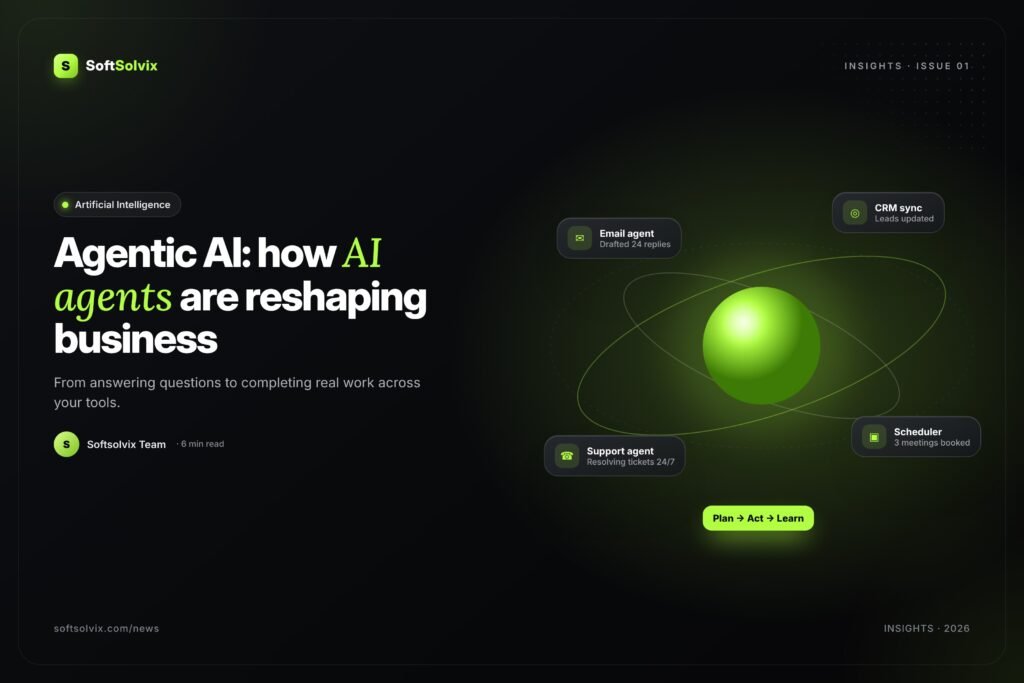
An AI agent is software powered by a large language model (LLM) that can break a goal into steps, use tools such as your CRM, database or email, check its own results and continue until the task is done. Where a traditional chatbot waits for the next prompt, an agent works toward an outcome.
- Goal-driven: you describe the result you want, not every click.
- Tool use: agents call APIs, search documents, update records and trigger workflows.
- Memory and context: they remember previous steps, customer history and business rules.
- Human in the loop: well-designed agents ask for approval before high-impact actions.
Why agentic AI is trending now
Analysts expect adoption to accelerate quickly. Gartner predicts that 40% of enterprise applications will feature task-specific AI agents by 2026, up from less than 5% in 2025. At the same time, Gartner has warned that many agentic AI projects will be cancelled because of unclear value or weak governance. The lesson is simple: the opportunity is huge, but success depends on choosing the right use cases and building agents properly.
High-ROI use cases for businesses
1. Customer support agents
Agents can resolve common questions, check order status, process returns and hand complex cases to a human with a full summary. This reduces response times and lets your team focus on high-value conversations.
2. Sales and lead qualification
An AI agent can respond to new website leads instantly, ask qualifying questions, enrich data and book meetings straight into your calendar.
3. Operations and back-office automation
From reading invoices and updating spreadsheets to scheduling drivers or tracking inventory, agents remove repetitive manual work. In fleet and logistics platforms, for example, an agent can monitor vehicle status and alert managers before problems grow.
4. Internal knowledge assistants
Give your team an assistant that searches policies, project files and past tickets to answer questions in seconds, with links to the original source.
How to build AI agents that actually work
Most failed AI projects share the same problems: no clear goal, poor data and no guardrails. Our approach at Softsolvix follows five steps:
- Start with one measurable process, such as first-response time or hours saved per week.
- Connect clean data through secure APIs and retrieval (RAG) so the agent answers from your real information.
- Design guardrails: permissions, approval steps, logging and fallback to a human.
- Build a great interface in your web dashboard or mobile app so people trust and adopt the agent.
- Measure and improve with analytics on accuracy, cost per task and user satisfaction.
Agentic AI and your existing apps
You do not need to replace your software to benefit. Agents can be added to your current web platform, admin dashboard or mobile app. Our GetBot AI project shows how multiple AI models, voice chat and document analysis can live inside one clean, user-friendly product.
Key takeaways
- Agentic AI turns AI from a writing tool into a digital team member that completes tasks.
- The best results come from narrow, high-volume processes with clear success metrics.
- Security, human approval and good UX are what separate successful agents from abandoned pilots.
Frequently asked questions
What is the difference between a chatbot and an AI agent?
A chatbot mainly answers questions in a conversation. An AI agent can plan steps, use tools such as your CRM or database, and take actions to complete a goal, often with human approval for important decisions.
Is agentic AI suitable for small businesses?
Yes. Small businesses often see the fastest returns by automating one repetitive process, such as lead follow-up or customer support, before expanding to other areas.
How long does it take to build an AI agent?
A focused pilot connected to one or two systems can often be delivered in a few weeks. Larger, multi-system agents with dashboards and analytics take longer, depending on integrations and data quality.
Work with Softsolvix
Ready to build something smarter? Softsolvix designs and develops custom mobile apps, web platforms and AI solutions for startups and growing businesses. Book a free consultation with our team, or explore our recent projects.